


Melia Dubia
Updated: Jun 13, 2022

Melia dubia Cavanellis is a fast growing short rotational indigenous tree species. The tree attains a volume of 15 cu. ft. at the end of 15 years and earns revenue of Rs. 200 per cubic foot from the 5th year onwards. It is a good secondary timber and the most preferred species for plywood industry. The wood is also used for packing cases, ceiling planks, building purposes, agricultural implements, pencils, match boxes, splints, cattamarans, musical instruments and tea boxes as the wood is anti-termite by itself. Thus, the species has a ready and assured market due to its multipurpose utilities. The species is also highly adaptable. The species is in high demand by the plywood industries where the production and capacity utilization has come down considerably due to non availability of raw materials. But, large-scale planting is hampered by its poor seed germination (less than 10 %), despite producing abundant quantities of fruits every year. As a result, planting stock is not available to the farmers and other planting agencies. Given the necessary research attention, it can be domesticated in massive scale.
Figure #1 - Core Veneer

Figure #2 - Core Veneer
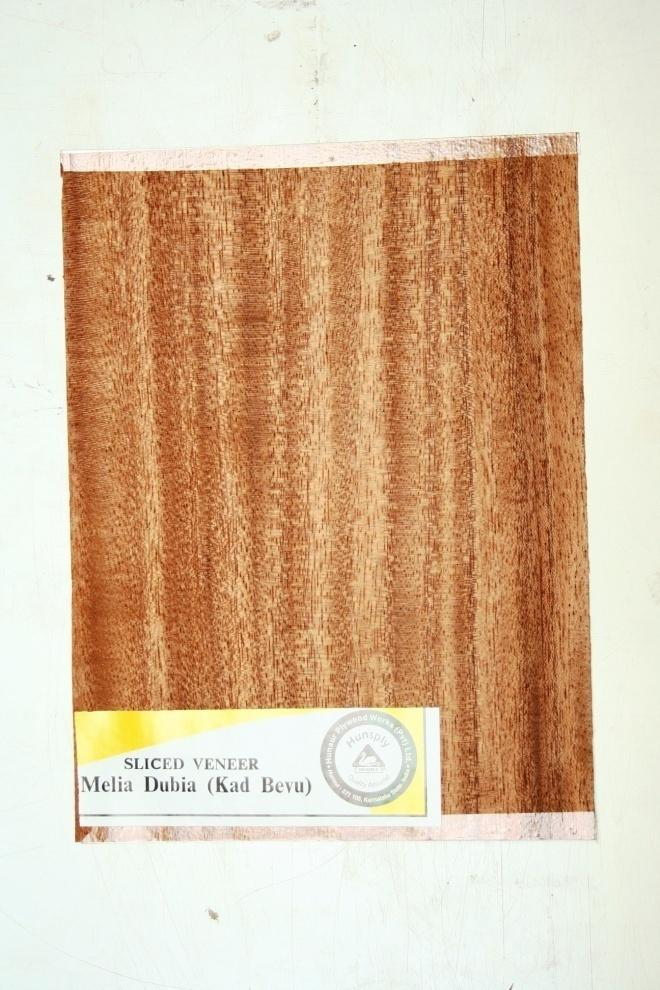
Figure #3 - Roof made from Melia wood

Fruit Processing and handling
It is best to adopt ground collection in Melia than obtain fruits by climbing and / or shaking the fruiting branches. Only ripe yellow or brown fruits should be collected. Collections from isolated trees should be avoided. The fruits can be transported to the place of processing in gunny bags or bamboo baskets and depulped following fermentation. Under natural conditions, ground fallen fruits are eaten by goats / deer which depulp the fruits and spit out the stony endocarp. The fermented fruits are macerated in bamboo baskets and thoroughly washed under running water so that even a small quantity of pulp is not adhered to the seeds. Sand can be used as an abrasive to remove the pulp thoroughly.
Storage and viability
The drupes thus extracted have to be sun-dried for ten days in shade. Cleaned and dried drupes can then be stored in gunny bags or sealed tins for one to two years without losing viability. The drupes stored for over a year show improved germination over fresh ones. No instances of pest incidence have been observed in the fresh or stored drupes of M.dubia. If the pulp is not thoroughly removed, the drupes are susceptible to fungal infestation. This can be overcome using Captan or Bavistin (@ 4 g/kg seeds).
Seed processing and pretreatments
Reports state very poor germination in Melia. Studies at IFGTB reveal germination as high as 60 percentage without any pretreatments. The drupes should be graded in water to remove floating seeds prior to sowing.
Nursery
Seed sowing: It is best to sow seeds during March – April. Cleaned and dried seeds should be sown in the open raised nursery beds, in drilled lines, 5 cm apart. Seeds do not germinate in sand. They have to be sown in soil: farm yard manure medium in the ratio 2:1. A 1:1 ratio can also be adopted. About 6-7 kg of dried drupes containing about 1500 numbers are required for one standard nursery bed. The seeds sown need to be watered regularly, twice a day. At places where daytime temperature is not very high, or where nursery beds are in shade, the bed should be covered with a tarpaulin sheet to retain temperature in the medium. Germination occurs within 90 days.
Note: The species is very sensitive to transplantation and hence care must be taken while prickling seedlings from bed or transplanting rooted shoots to bags.


Vegetative propagation
Juvenile stem cuttings and coppice shoots respond well to 1000 – 2000 ppm IBA (liquid formulation). Coppice from older trees responds better to rooting. Pencil thick cuttings need to be taken for propagation. Thin shoots are easily susceptible to root rot. The shoots can be placed on sand medium and watered twice a day. A provision for drainage is a must as water logging destroys the shoots. In cuttings, season plays a major role in rooting . Drier seasons are conducive for rooting. About 75 percentage rooting can be obtained.


Growth statistics
Growth statistics vary from region to region depending on site and environmental factors. The general observation is that if plantations are established with better spacing in favourable conditions, growth rate is high. The irrigated plantations attain GBH of 82 cm while under rainfed conditions, the GBH is 48 cm at the fifth year. The tree generally branches after attaining a height of 12 – 13 m.
Agroforestry
The species has been planted as intercrop among coconut trees, Groundnut, Blackgram and Greengram. It was also observed to perform well as a bund plant for Casuarina, banana, drumstick and sugarcane plantations and Mango orchards. The species supports cultivation of tomato/ turmeric/ papaya underneath. It is also grown as a shade tree in coffee and tea plantations.


Economics***
The information provided in this section has been obtained from Hunsur Plywood Works Pvt. Ltd., Hunsur, Karnataka based on the growth performance of the species planted by the concern in 1995 and evaluated at the end of 15 years. Ten trees were selected and harvested. The trees had an average bole length of 8.90 m and a girth of about 100 cm producing approximately 0.425 cu.m. (15 Cu.ft) per tree. These logs can be used for core veneer by peeling and logs of smaller sizes can also be utilized. Trees with a minimum of 16 inches (40 cm) girth are saleable at the rate of Rs 2000 per tonne for match industry.
Area of the plantation | 1 Acre (0.40 ha) |
Species planted | Melia dubia |
Spacing | 6 x 6 m |
Total trees planted (Block) | 108 |
Per cent survival | 90 |
Total expenditure for plantation (includes establishment, weeding, manuring, watering) up to maturity | 6000 /- |
Average height of the plantation | 7.84 m |
Average girth of the plantation | 96 cm |
Average yield per tree* | 15 Cu.ft. (0.425 cu.m) |
Market value of the timber (current price) | Rs. 280/- per cu.ft (boles with length > 8.5 m and GBH 115 cm fetch higher prices) |
Average value per tree | 280 x 15 = 4200/- |
Current value of the plantation^ | 4200 x 97 = 4,07,400/- |
Net profit | 4,01,400 |
* Only clear bole is taken into account. Lops and tops are not accounted for.
^ Cost of land not included
This performance of the species can be expected only under good maintenance and controlled irrigation upto atleast six years. Unattended plantations with weed growth, poor soil conditions, water logging, etc., do not produce logs of the desired size. If bund planting is taken up in a single row about 60 trees can be planted at 5 m spacing which will fetch an income of about Rs.2 lakhs in the sixth year, as trees planted along bunds have been recorded to put on girth faster than the block planted material.
If the plantation is maintained for 30 years, the logs fetch higher prices (Rs. 650/- per cu.ft ) as the utility value of the wood is increased. The logs can be used for face veneer and the process is more akin to splitting for which larger sized logs are required.
Economics – based on field observations and prices fixed as MSP by plywood manufacturers (as on 2013-14)For a Block plantation with no intercropping (at the end of five years)
Revenue from Final Harvest (@80 tonnes/ha) : Rs. 6,00,000/- (@Rs.7500/- per tonne – fixed by Plywood manufacturers)
For a Block plantation with no intercropping (at the end of fifteen years)
Revenue from Final Harvest (@Rs.375/- per cu.ft) : Rs. 15,50,000/- (Varies from Rs. 375 to Rs. 700/- depending on its suitability for face veneer – fixed by Plywood manufacturers)
***All figures provided are likely returns assuming present market rates. This is subject to volatility. However, during the past two years, it has remained between Rs.6000-7500/- per tonne.


Comments