


Eucalyptus
Updated: Jun 14, 2022

Eucalyptus belongs to the family Myrtaceae. The species can withstand extremities of the temperature and rainfall. It is a best suitable tree species for the areas which received rainfall from 250 to 600 mm and at the same time it can also grow well in high rainfall areas, water logged areas and irrigated farmlands. There are many species of Eucalyptus suitable for different altitudinal and climatic ranges. This species occurs on a variety of soil types as well as salt affected areas, except calcareous soils.
Extent of plantations
Eucalyptus is one of the widely planted tree species and in India around 4 million hectares of planted area (Iglesias et al., 2009). Annually about 1.5 lakh hectare is planted mainly with clonally propagated plants. The climatic adaptability and superior in growth rate makes Eucalyptus a major species among the few other pulpwood species present in India.
Major Uses and Services
Wood is mainly used as pulpwood and poles. Mature tree logs may be sawn for construction timber, furniture and ply. Spiral splitting is one of the major problem with logs when extracted at young age. Preservation treatment is necessary for durability in the ground (White, 1988). Eucalyptus leaves are traditional herbal medicine. The essential oil found in the leaves is used for relieving coughs and colds, sore throats and other infections (Chevallier, 1996). It can also be inhaled for treating nasal block.

Image: Pulpwood sale
Seed and Nursery techniques
Generally flowers once in a year induced by dry weather. Maturation time is about 3 months. The breeding system is mixed mating with predominant outcrossing. Self-pollination generally results in reduction in capsule production, seed yield and seedling vigour.
Maturing fruit will turn from green to brownish-red with prominent ridges on the top when the fruits ripe. Capsule opening takes 2-3 months period when present in the tree. However, once they are collected from the tree, seeds dehisce on shade drying in 2-3 days. It produces heavy seed crop after every 2-3 years (Walsh & Entwisle, 1996).
Seed can be distinguished from chaff as the seeds are bigger and round while chaff will be small and elongated. Seeds weigh approximately 700 seeds/gram. The seeds can be stored for more than 10 years if they are placed in hermetic containers at a temperature of 3 to 5 °C and a moisture content of 6 to 10 percent.
Seeds germinate readily without any pre-treatment. Germination can be maximized under moist, warm (32°C) conditions in the presence of light. Seeds are eaten by ants hence need to be protected during storage and germination.
For all Eucalypts, the texture of the medium of germination must be fine. A fertile mixture of soils with sand in a proportion of 1:1 must be used. Seed should be sown under shade on a free-draining and sterilized medium and covered very sparingly with inert material (e.g. sand). Seeds must be sowed deep enough to prevent uncovering when watered and at the same time they must not be too embedded. The germination period for this method ranges from 4 to 5 days. The seedlings are lifted from the mother bed when they are 5 to 7 cm in height and transplanted in poly bags.
Shade cover is needed after transplanting till six weeks. Growth is fast under tropical conditions and plants could reach plantable size (30 cm) in 4 to 5 months. Seedlings require daily watering up to 3 months. To prevent damping off, cupric fungicides should be applied. About 1-2 lakhs seedlings can be raised from 1 kg of seed.

Image: Mature fruit

Image: Seed Extraction

Image: Germinated seedlings
Cultivation practices
Weeding and removal of underbrush are recommended before planting. The ability of the species to compete with weeds is poor. In high rainfall areas, 2-3 times weeding per year is essential until closure of canopy (2-3 years). Inadequate weed control may lead to complete failure of the plantation.
Pulpwood plantations are made with a spacing of 3 m x 2 m (1667 trees/ha) to 3m x 1.35m (2470 trees/ha). For energy plantations, a spacing of 2x2 m is recommended. In India, Eucalyptus is managed for pulpwood under clear-felling system followed by coppice rotation for two times. After three rotations, the below ground biomass is taken out and replanted with seedlings. Depending on the fertility and availability of water, the rotation can fixed from 5 year to 6 years for pulpwood.
Trees planted at a spacing of 2 x 2m are thinned to 4 m x 4 m after three years and the thinned materials are used as posts, poles and fuel wood, leaving the better trees to grow-on to 10 years for products like plywood and sawn timber.
Application of 100g of NP or NPK (3:2:1) fertilizer to each tree at planting to assist establishment of growth is common. Crown die-back during dry-season as a result of boron deficiency is prevalent and must be observed. A dosage of 10-20 g of borax per tree depending on soil type is applied.
Felling during summer delays sprouting and increases the stump mortality. Felling is normally carried out using power saw that is cheap, quick and gives minimum damage to bark. After six months of coppice shoot formation, one or two shoots alone must be allowed to grow and the rest of the shoots must be removed.

Image: Coppice shoots after 1st rotation

Image: Coppice rotation
Agroforestry practices:
Eucalypts have relatively narrow crown and pendulous leaves which allow light to pass the forest floor. A wide range of crops like groundnut, chilly, onion, leguminous plants, etc can be grown. Under a normal spacing of 3 x 2m, intercropping is recommended for one year. Wide spacing of 5 m x 2 m can be given and intercropping can be carried out for three years. Alternatively, paired row method of planting with 5 x 1 x1 m spacing is also practiced for maximizing the pulpwood as well as agricultural crops.

Image: Paired row planting at 5 x 1 x 1 m
Clonal propagation
Eucalyptus is propagated clonally through juvenile cuttings. Juvenile cuttings are induced by coppicing at a height of 4 inches from the ground. The shoots multiplied from the selected plus trees are rooted and planted in Vegetative Multiplication Garden (VMG) at 1x1 meter spacing. These plants are allowed to grow for 6 months and coppiced to produce multiple shoots. After 3-4 weeks of shoot formation, these shoots are collected from the plants and cut into sections with two leaves and a small stem.
These cuttings are placed in vermiculate medium after treating with 3000 ppm of IBA growth hormone in mist chambers. Root initiation starts after for 3-4 weeks period of time. The rooted plants are hardened by exposing the seedlings to higher levels of sun light and reducing the watering in 3-4 months period. Six months old plants raised in 100 cc root trainers are ready for planting.
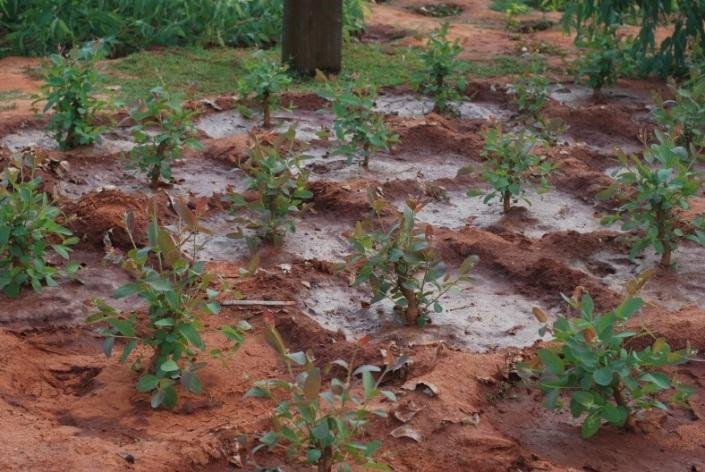
Image: Vegetative multiplication garden
Current productivity
In Tamil Nadu, about 10-15 t/ha at a rotation of 7 years was realized through seed raised plantations during early 1990’s. Clonal forestry, has emerged as a new revolutionary technology to substantially enhance the productivity of Eucalyptus plantations to 20 m3ha-1yr-1 in an average site quality area. The productivity increases up to 70 m3 ha-1yr1 in a fertile deep soil with surplus water availability.
Clone-site matching is an essential aspect considered to maximize the productivity of the plantations. Selection of the correct genetic material for the particular planting site is of paramount importance. There is a great variation in growth of these clones across locations. Few clones are suitable for deep soil and few are suitable for saline and few are for gravelly soils. Hence choice of clone for a particular locality is first and foremost issue for the success of a planting programme.
New varieties developed / released
Introduction of clonal technology increased the cultivation of Eucalyptus due to its superiority in uniformity and higher productivity. Although many clones have been introduced after careful hybridization and or selection, at present there are less than half a dozen clones only planted widely across the country. These clones are being multiplied by paper industries, private nurseries and Forest Corporations for the past three decades, used for their planting programmes and sold to farmers.
During 2010, four Eucalyptus camaldulensis clones viz., IFGTB-EC1, IFGTB-EC2, IFGTB-EC3 and IFGTB-EC4 were released after multilocation clonal trials for cultivation in Tamil Nadu and Andhra Pradesh for higher productivity. Among these clones, IFGTB-EC4 expressed superiority in its growth.
The productivity of IFGTB-EC4 is observed to be 25 m3ha-1yr-1 which is about 25% more when compared to other commercially planted clones. Considering the growth superiority and the rooting potential, IFGTB-EC4 is multiplied largely by Tamil Nadu Newsprint and Papers Limited (TNPL), Seshasayee Paper & Boards Limited (SPB), JK Paper mills and Tamil Nadu Forest Plantation Corporation Limited (TAFCORN) and planted widely by farmers. At present, annually about 6 million clonal plants of IFGTB-EC4 is multiplied, planted in an area of 3100 ha and each farmer is benefited with Rs.50,000 per ha.
Most of the planted clones could not thrive when there was an outbreak of Leptocibe invasa (Gall insect) during 2008 in southern states. Efforts were taken to identify gall insect tolerant clones through multi-locational testing in eighteen sites covering the hotspot areas of the outbreak in Tamil Nadu, Karnataka and Andhra Pradesh. Seven clones viz., IFGTBEC5, IFGTB-EC6, IFGTB-EC7, IFGTB-EC8, IFGTB-EC9, IFGTB-EC10 and IFGTB-EC11 were released during 2014 for higher productivity and resistance to gall infestation. The growth of IFGTB-EC6 and IFGTB-EC9 show comparable growth with other commercially planted clones. IFGTB-EC11 grows well in irrigated farmlands. IFGTB-EC6 has provisional IP protection from PPV&FRA and is commercially licensed for mass multiplication and sale to farmers.

Image: IFGTB-EC4 at Pudukottai (age: 4 years)
Insect and disease problems and control measures
In the nursery, it is susceptible to diverse fungi causing damping-off, collar rot and leaf blight. Leaf blight spread to the entire nursery stock during rainy season. Nursery hygiene and optimal watering are warranted. Termites damage the root of the planted seedlings and young trees and must be chemically controlled.
Eucalyptus is severely attacked by an invasive gall insect (Leptocybe invasa) which lead to formation gall like structure in the midrip and petiole and young stem. The problem is severe in young seedlings and coppice shoots. Chemical control is difficult and hence resistant clones must be planted.


Comments